
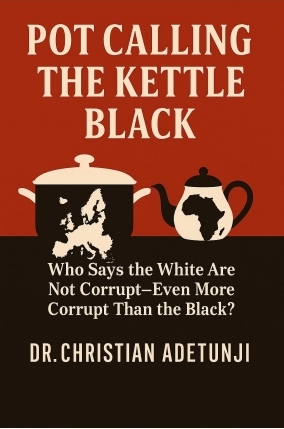
POT CALLING THE KETTLE BLACK Who Says the White Are Not Corrupt Even More Corrupt Than the Black?
I am no activist—only a quiet watcher of the world’s long theatre. At sixty years, I sit with an old accounting principle in mind: every debit must have a corresponding credit. When one side is recorded and the other concealed, the account is false. Africa’s wealth, including its gold, oil, labour, culture, and blood, did not disappear overnight. They travelled—quietly—into foreign vaults, polished institutions, and respectable economies. And the violence, instability, and poverty that followed also had a sender, a signature, and a design. Yet the world insists on a familiar story: Africa is corrupt; the West is moral.
This book asks a simple but uncomfortable question: what if that moral superiority is an illusion? Pot Calling the Kettle Black exposes how corruption wears different clothes. In Africa, it is loud, customised, and criminalised. In the West, it is quiet, legalised, and sanitised—hidden behind contracts, lobbyists, tax havens, media narratives, and institutional respectability. This book argues that corruption has no colour. But the world has been trained to associate it with Blackness while excusing it when it speaks with an accent, wears a suit, or operates through law.
“POT CALLING THE KETTLE BLACK” is not a defence of African failures. It is a demand for moral consistency. Before passing judgement on Africa’s shortcomings, the global system needs to address its own shortcomings. This book is an invitation—to rethink power, question inherited narratives, and rebalance the moral ledger of history. Truth will demand reconciliation when we finally open the books.

Reviews
There are no reviews yet.